Monday, July 28, 2008

Status of India after 61 Years of Independence

India is going to complete 61 years of Independence on 15th August, 2008. Now, one more year is going to get added when we can proudly call ourselves a free nation. But, are we free in real terms? Does it make sense to celebrate this day with great pomp and show when we are still living under the clutches of poverty, corruption, injustice, inequality and most importantly, illiteracy? At least, I don't think so.

Inequality in different forms is still the face of free India. It mainly exists on the basis of gender and caste. Let us take the case of inequality on the basis of gender. Although a lot has been done for the upliftment of women and more and more women are attaining equality with their male counterparts, yet there are many women who get suppressed by their family and society on matters like pursuing higher studies or choosing a life partner or having a say in family planning or wearing a dress of her choice. Another aspect of such kind of inequality is the preference for male child, still prevalent in many parts of our country largely evident by the rampant female infanticide. Even today, when I let people know that we are only two daughters of our parents, they give an astonished look as if my parents are living an unhappy life without a son. People are also facing discrimination on the basis of caste. Let me just remind you all of an incident took place last year. An ex-army personnel belonging to a lower caste was beaten to death by his own villagers when he tried to dig a well on his land for farming. Now, what kind of achievement of India does it show after so many years of independence?

If inequality is an evil we still need to fight strongly, poverty is another major issue still holding our country in the league of third world countries. In fact, poverty has resulted into another kind of inequality between rich and poor. On one hand, you find those affluent people who can spend one lakh rupee just on a single dinner with their friends and family in a five or seven star hotel, while on the other hand, you find people living on streets with no proper clothing, food and other basic necessities.

Poverty has also resulted into a major social evil and that is child labor. In my locality, there is a slum area where majority of children are the bread earners for their family without any time to attend government schools. Their financial condition does not allow them to attend a full session in the school. If they at all are attending classes, it is only for satiating their hunger with mid day meals. But, this problem has got another dimension. There is a class of people who have literally no interest in making their children educated and look at them only as an additional source of income. So, isn't there a need to take a strong initiative by the government to make these people let their children attend school? Only constructing school buildings is not enough, I think.

It is not only poverty that is spelling a curse on common people, but also corruption. The common man of our free nation still needs to bow his head to corruption, which is rampantly found in our administrative machinery. If I ask you, how many times you had to pay some kind of bribe to get your work done, I am sure you would have forgotten the number as it has become close to countless.

There are many other issues that show our susceptibility to get succumbed to pressures at individual level as well as national level. So, shall we celebrate this day? Of course, but in a way that promises a great future for every Indian in coming years. On this day, we all should take a vow to join hands and cooperate with our government to get our nation free of all evils so that we get a reason to celebrate this day in true sense.

Wednesday, July 16, 2008

Raksha Bandhan - A Festival of Bonds

Come August and I gear up for one of the most revered festivals of the Indian Calendar. Yes this is the festival of bonds that I am talking - 'Raksha Bandhan' or more popularly Rakhi. I specially look forward to this festival as my brothers visit me on this day, no matter in which part of the country they are. where they are stationed It is on Rakhi that we revive those vows which we had taken ever since we were born.

For the ones who are not tête-à-tête with the festival, Rakhi captures the essence of the relationship between a brother and sister. Raksha means 'to protect', and Bandhan means a 'bond', therefore Rakhi is a bond of protection. Like every sister, I tie a band or an amulet around my brother's wrist as a protecting charm and pray for his wellbeing. My brother in turn vows to protect me from all sorts of evils and perils of the world. The festival is celebrated on the "Shravan Sud Poornima" every year, according to the Hindu calendar. An inetegral part of my rakhi celebrations are the gifts that my brothers lovingly shower upon me. The mere thought of the box of chocolates or the new dress that might be in store for me still brings a glitter to my eyes.

This festival has special meaning for me and my entire family as it very fondly reminds us of my grandmother. As children, I use to hear the mesmerizing legend behind Rakhi or Raksha Bandhan. Since time immemorial this festival has been attached to the ritual of protecting your loved ones from the evils of the world. The tradition actually dates back to the Mahabharata and the Hindu Mythological Godhead 'Indra.'

Rakhi is fun time as it also serves the purpose of a refreshing family get-together. The entire house basks with the presence of relatives from all corners of the country. Be it my paternal aunt or my maternal uncles, it is fun to have all of them under one roof.

Now, with Rakhi just round the corner, my mind is full of joy and I am waiting for all the action to happen. It’s not just me, I am sure that all sisters are waiting for it too.

Wednesday, July 2, 2008

Amarnath Land Controversy - Was This Move Required?


The controversy in the state of Jammu & Kashmir on the allocation of 100 acres of the land to the Amarnath Shrine board has brought forth the pent-up sentiments of the Muslim residents in the area. This move on the part of the Government has large repercussions on the already volatile political scenario in Jammu and Kashmir. This thoughtless move was a clear attempt to lure the Hindu residents' votes in the area, but it has resulted in uprooting the entire normalcy in the state. Ever since this announcement was made, it was evident that the Muslim residents in the state would raise their voice against it. However, an even stronger impact on this has been from the Separatist forces, who have taken this platform to draw the pro-India populace to their side.

As a result of all this political flutter, the PDP had also gone on to pressurize the Government to withdraw the land order, so as to satiate the feelings of the Muslim voters in the state. In fact, the PDP had even threatened to withdraw its support from the coalition government if this was not implemented. As a result, the Congress government in the state succumbed to the pressure and has taken back their move.

But all these developments raise a pertinent question in our minds that was this step really required? In the volatile states of Jammu and Kashmir, where the public feeling has always been bent towards Pakistan, such an inconsiderate move only ignites the fire that has always been given air by the separatist forces. The peace and tranquil atmosphere was predominant in the state from the past few years and everyone was hoping that things would be normalized again. But, with this move, things have again been pushed to the same politically corroded state.

Saturday, June 21, 2008

Amarnath Yatra - Holy place of India

India is land of age old spiritualism. Unlike other religions Hinduism, the main stay of India does not recognize a single prophet and idolizes innumerable gods and goddesses. Evidently, the country also has numerous pilgrimages scattered throughout, from north to south. One such pilgrimage that holds enormous significance for Hindus is the Amarnath Yatra. I have been fortunate enough to take this yatra last year. It was such a memorable journey that I want to share my experience with you. This Yatra or journey is taken up by devotees during ‘shravana’ or the monsoon season. So, I along with my friends started our pilgrimage to Amarnath on 15th of July as Darshan at the Holy Cave is generally open from early July (Ashad Purnima) to early August (Sharvan Purnima).
For yatra to Baba Amarnath Holy Cave, we have to trek a height of about 14,500 ft and the journey was full of joy and thrills. The environment was divine and we were feeling as we are walking through the heaven on earth. It is said that the devotees attain ‘Moksha’ or freedom from rebirth by reaching to this cave of Lord Shiva- the most important God Head of Hindu mythology and even we were thinking it to be true. Pilgrims gather from all around the world to offer their prayers to the ‘Shivlinga’ residing in the cave. Surrounded by beautiful valleys and mountains, we felt like walking in the Kailasha hills which is said to be the abode of lord Shiva. The enchanting of mantras and the religious slogans like “Bam Bam Bhole”, “Jai Baba Amaranth”, “Jai Baba Barfani” and others made us feel the presence of lord Shiva everywhere around me. It was such an experience that would hardly vanish with time. I feel the journey to the Amarnath cave is such that pilgrims can rediscover Mother Nature and her love for human beings.

Legend has it that Shiva recounted to his wife Parvati, the secret of creation in a cave in Amarnath. Unknown to them, a pair of mating doves heard this conversation and having learned the secret were reborn again and again and they made the cave their eternal abode. Many pilgrims report seeing the doves-pair, when they trek the arduous route to pay obeisance before the ice-lingam (the phallic symbol of Shiva), but I was not that fortunate to see them.

The Amarnath Yatra is conducted once in year by the Jammu and Kashmir Government. The climatic conditions are extremely uncertain. Rain or snowfall may take place at any time or place during the Yatra. It is to be particularly noted that abrupt changes in temperature might occur. Sunny weather may turn into rain / snow fall in a short span of time. The temperature also may fall up to -5 degree Celsius. Uncertain climatic conditions often make the journey unpleasant and difficult for the pilgrims and you should take proper care and make adequate arrangement before taking up Amarnath Yatra. Such is the faith and dedication, that all pilgrims brave the adverse conditions and reach the abode of their God. But, one thing that really hurt me was the garbage being spread by the pilgrims which is causing great environmental hazard to this beautiful abode of God. I think persons should behave little responsibly and should not indulge in such things. Then, only we would be able to save the utmost beauty of nature coupled with divinity.

Wednesday, June 11, 2008

Rath Yatra - The Orrissan festivals


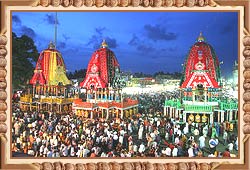
India is a land of festivals. Every part of this country has a different festival to celebrate. Each of them has a separate background and a special significance of their own. Amongst the seem-to-be-countless such religious occasions, the Rath Yatra at Puri is extremely well known. Devotees from all over the country flock to this region of Orissa to have a mere glimpse of their favorite God.

Better known as Jagannath Rath Yatra or 'the chariot journey of Lord Jagannatha', the festival is observed in the month of Ashadha (June-July). The historical-religious event commemorates the annual visit of Lord Jagannath to his birthplace Gundicha Mandir (temple). A conglomeration of millions of people can be seen at the Jagannath temple at Puri during this chariot festival, which is celebrated for eight consecutive days.

The festival commences with several rituals and offerings to Lord Jagannatha. Then the king of Puri or any descendant of the royal dynasty brings the idols of their respective beautifully decked chariots lined up before the temple. He sweeps the chariots' platforms with a gold-handled broom and sprinkles scented water. It is only the King of Puri and the King of Nepal who are allowed to touch the idols as they belong to the Chandravanshi dynasty.

Now, the Images of Lord Jagannath - Lord of the Universe, his sister Subhadra and brother Balbhadra are taken out in a procession in three magnanimous chariots. The main chariot is 14 meters high and 10 meters square with 16 wheels. It is said that one can attain salvation with a single view of the Gods in their chariots. However, in the olden days, the die-hard devotees used to throw themselves under the wheels of the raths with the believe to free their soul from the cycle of birth-and re-birth.

The chariots of the Gods are drawn by the devotees to the Gundicha Mandir amidst devotional songs and prayers. After a week's stay here, on the tenth day, the 'Ashadha Sukla Dasami', the deities start their return journey. The return of the Lords is called 'Bahuda Yatra' or 'Phera Rath Yatra'. The journey of the Lord's chariot to and from its sanctum-sanctorum is believed to purge and purify the city.

To seek detailed information on Jagannath Rath Yatra, you can log on to www.festivals-culture.blogspot.com

Sunday, February 3, 2008

Valentine’s Day


"Within you, I lose myself.
Without you, I find myself wanting to be lost again."

Celebrated on February 14 every year, Valentine’s Day is celebrated as the festival of love. Lovers cherish this day to express their feelings to their dearly-loved ones along with flowers, gifts, cards and chocolates. The day for lovers is celebrated all over the world including Europe, Asia, Africa and America. The exchange of chocolates and flowers is traditional on Valentine's Day in America. Flowers, cards and gifts businesses make brisk trade on the occasion.

People in some countries celebrate this day differently. In some North American elementary schools, students give a Valentine card or a small gift to everyone in the class. The greeting cards exchanged between students mention what they appreciate about each other. In Slovenia, a proverb says that "St Valentine brings the keys of roots," so on February 14, plants and flowers start to grow.

This day has been celebrated in Europe since long. There is literary record conveying that the day was celebrated by people in some countries of the continent. The day was associated with romantic love in the circle of Geoffrey Chaucer in High Middle Ages, when the tradition of courtly love flourished. The day was closely associated with the mutual exchange of love notes in the form of "Valentines". Valentine's Day and romance has found mention in Chaucer's Parliament of Foules. This day is also mentioned by Ophelia in Hamlet: "Tomorrow is Saint Valentine's Day."

On this day, it is believed that people earlier offered their loved ones handwritten notes expressing their feelings for them. And since 19th century, handwritten notes have given way to printed greeting cards. Since the mid-19th century, greeting card-makers all over the world have a field day on this special day. In the second half of the 20th century, the practice of exchanging cards was extended to all manner of gifts in the US, usually from a man to a woman. Such gifts typically include roses and chocolates. In the 1980s, the diamond industry started to promote the day as an occasion for presenting jewelry as a gift to loved ones.

Now on Valentine's Day, people send greeting cards widely. US Greeting Card Association estimates that about one billion cards are sent each year worldwide, making the day the second largest card-sending holiday of the year behind Christmas. The association estimates that women buy approximately 85 per cent of the Valentine Cards.

Saturday, February 2, 2008

Republic Day


India celebrates January 26th every year as the Republic Day with zeal and pride all across the nation. Hoisting of the tri-colour and colorful parades at all administrative units such as the capital cities and district headquarters mark the celebration on this day. The major ceremonies are held in New Delhi and the state capitals. On this day in 1950, the India’s constitution came into force and it became a sovereign, democratic and republic state.

In the country’s capital New Delhi, main celebrations are organized in the form of a majestic parade showcasing the country's military might and cultural diversity. The parade covers an eight-km route, starting from the Rashtrapati Bhavan through the picturesque Rajpath down to India Gate before winding up at the historic Red Fort.

The parade consists of mechanised, mounted and marching contingents of the Army, Air Force, Navy, Paramilitary forces and Police. After the march past, models of lethal fighter jets, missiles and battle tanks are displayed. Then the cultural extravaganza consisting of floats are presented by various States. The cultural exhibits depict scenes of activities of people in different States and the music and songs of that particular State accompany each display. Each display brings out the diversity and richness of the Indian culture and the whole show lends a festive air to the occasion.

The events of the day begin with the Prime Minister laying a wreath at the Amar Jawan Jyoti at India Gate in memory of the martyrs and soldiers who laid down their lives for the country. He then drives up to the central enclosure and awaits the arrival of the President and the Chief Guest of the occasion who is generally a Head of another country.

On his arrival, the President meets the dignitaries present there and unfurls the national flag. After this, the national anthem is played with a 21-gun salute to the national flag. Then, in a brief investiture ceremony, the President presents India's top gallantry awards, the Param Veer Chakra, the Veer Chakra and the Maha Veer Chakra to outstanding soldiers from the defence services.

After that, four helicopters fly past the parade area showering rose petals on the audience. Each chopper carries a flag - the first being the National flag and the other three, the flags of the Army, the Navy, and the Indian Air Force. The march past begins immediately after the fly past.

Children also take part in the celebrations a big way in their respective schools all over the country. Three days after the Republic Day parade, a moving ceremony known as "Beating Retreat" is held at the Vijay Chowk in New Delhi. This ceremony marks the formal end of the Republic Day celebrations.